About Me

Massive film fan, and first year History student.

Follow me on Twitter: www.twitter.com/willliampalmer

Showing posts with label academy awards. Show all posts

Sunday, 24 February 2013

My Oscar Predictions


Regardless of your opinions on the Oscars, the Academy and awards ceremonies in general, there’s no doubt that 2012 has been a pretty brilliant year for film. We had a superb array of summer blockbusters that filled theaters and broke box office records everywhere. We were treated to the best Bond film in years in what is the spy’s 50th anniversary. Directors went above and beyond, specifically in terms of visuals as film makers continue to grapple with the digital vs film argument. This year's Oscar nominations did not surprise me, and I can safely say I enjoyed most of the films on the list, as opposed to 2011s forgettable nominations. It was also nice to see a couple of surprises with Beasts Of The Southern Wild getting 4 nods, continued support of independent cinema by the industry is a must, and despite the continued ignorance of audience favorites (Looper, The Dark Knight Rises, The Avengers, Ted), the recognition for Beasts and the singular nod for Moonrise Kingdom gives me some hope. So without further a-due, here are my predictions for the 85th Academy Awards:  

Best Film: Argo


If you’d asked me who would have won Best Film before the Golden Globes I would have told you Lincoln, but after Affleck and co sweeping the Globes, Screen Actors Guild Awards and the BAFTAs then I'm going to assume that Argo will win this category. Plus the added snubbing of Affleck in the Best Director category will go in the film’s favour. I still wouldn’t rule out Lincoln winning it, or indeed Zero Dark Thirty, Silver Linings Playbook, Life of Pi or Les Miserables, they all still have solid chances, but after post-Globes buzz, Argo stands the strongest chance. I doubt Amour will win as it is more than likely to win in the Best Foreign Film category, its nomination is nothing more than recognition. If it were up to me I’d give the award to Beasts Of the Southern Wild or Django Unchained, both two of my favorite films in 2012, but Django stands an outside chance at best and Beasts’ nomination is much for the same reason as Amour’s inclusion. That doesn’t mean Argo is more than a worthy winner, it was brilliantly suspenseful and thrilling, and deserves all the plaudits it gets. 

Best Director: David O’ Russell (Silver Linings Playbook)


This category is much more tricky. Had Affleck been nominated he would have been firm favorite, but in his absence it makes this category much more interesting. While many will view O’Russell (Silver Linings Playbook) as an outsider here, with Spielberg (Lincoln) and Michael Haneke (Amour) favourites on the list, I’m gunning for O’Russell. Maybe it’s more hope than logic but the Academy throws out a few surprises each year and I’d like to think they’ll dole one out for Best Director. Life Of Pi seems to have lost ground over the last couple of months, so I’m doubting Ang Lee will be walking out with this award while debut director Benh Zeitlin (Beasts Of The Southern Wild), undeservedly may I add, is unlikely to win. 

Best Actor: Daniel Day-Lewis (Lincoln)


The firm favourite! This award is essentially wrapped up, with Day-Lewis a guarantee to take the award home to give the Lincoln actor a third record breaking Best Actor Oscar. His portrayal of the 16th President was nothing short of flawless, an intimate, stirring and charming performance. That’s not to say the other actors on the list aren’t deserving of credit, Hugh Jackman’s Jean Valjean in Les Miserables was terrific, and easily one of Jackman’s best performances in years. Joaquin Phoenix was disturbingly electric in The Master, and would also very much deserve the award, while I felt Bradley Cooper’s Silver Lining’s Playbook performance never really dazzled, and would have preferred to have a more deserving actor on this list. However with the Academy’s affinity for patriotic period movies and a clearly incredible performance by Day-Lewis, this category is a dead cert. 

Best Actress: Jennifer Lawrence (Silver Linings Playbook)


Again, this category is quite open with both the oldest Best Actress nomination ever (Emmanuelle Riva) and the youngest (Quvenzhane Wallis) competing against each other. While Jessica Chastain (Zero Dark Thirty) won the Golden Globe, Emmanuelle Riva (Amour) won the BAFTA, with Lawrence still somehow remaining the favourite throughout. Many people feel Riva very much deserves the Oscar, she is 85 and has been acting for over sixty years, and her Amour performance is beautiful, supporters of Riva will also say Lawrence, 22, still has many years ahead to win awards. Despite Riva’s incredible career, I still feel the Academy will go with Lawrence, whose Silver Lining’s Playbook performance is just as deserving of awards as Riva. I’d still love it if Jessica Chastain won, she had one of the best performances of 2012 in Zero Dark Thirty, playing an intelligent, determined CIA operative on the hunt for Bin Laden, but she seems to have slipped as favourite, don’t be surprised if she walks away with the award though. Beasts actress Quvenzhane Wallis who at only 9 years old has deservedly earned herself a nod, will almost certainly not win. At 9 years old there would be no point putting pressure on a career that has barely even begun by handing her an Oscar, it’s nice that she’s been recognized though. 

Best Supporting Actor: Tommy Lee Jones (Lincoln)


Probably the most interesting category! All five actors have won Oscars before, none have anything to prove, so it’s very wide open. So I suppose my prediction here is very much less influenced by Academy politics, and based purely on performance, in which case I’d give it to Tommy Lee Jones (Lincoln). If it weren’t for Day-Lewis, Lee Jones would have stolen the film in an honest portrayal of Republican radical Thaddeus Stevens. Alan Arkin was hilarious as ever in Argo, Christopher Waltz his usual playful self in Django Unchained, Phillip Seymour Hoffman was terrific in The Master and Robert DeNiro gave a heartfelt if not sometimes all to similar performance in Silver Lining’s Playbook. However Waltz won this same award back in 2009 for Tarantino’s Inglorious Bastards so it would have appeared Waltz wasn’t the favourite but with his win at the BAFTAs 2 weeks ago it remains to be seen that he could still walk away with the award. If there was any justice Leonardo DiCaprio would have been nominated in this category, he was everything from charming to brutal to manic in Django Unchained, but sadly this is not the case. Either way, my money’s on Tommy Lee Jones, but expect anyone to walk away with the award in this category. 

Best Supporting Actress: Anne Hathaway (Les Miserables) 


Another award already tied up. This seems to have been a guarantee for months, having brought most cinema goers to their knees in tears with her portrayal of Fantine in Les Miserables. It is a compelling and emotionally draining performance by the actress, and the award will continue to cement Hathaway as one of the Hollywood’s current best. Elsewhere in the category Sally Field was brilliant as Mary Todd Lincoln in Lincoln and you’d think if there was a 2nd place award she’d almost certainly win it, while Amy Adams was awkwardly brilliant in The Master playing the deluded wife of cult leader Lancaster Dodd (Phillip Seymour Hoffman). They’ve probably all started practicing their losing faces though, while Hathaway must have her ‘oh wow I've won I'm so surprised’ look nailed by now. 

Best Adapted Screenplay: Argo (Written by Chris Terrio) 


I think this category could be very much a toss up between Argo and Lincoln (written by 
Tony Kushner). Kushner was the favourite in this category but Terrio’s Argo reigned supreme at the Writer’s Guild Awards last week, and if Argo wins Best Film expect the Academy to give Terrio the nod.

Best Original Screenplay: Django Unchained (Written by Quentin Tarantino)


It would be lovely to see the Academy give Django Best Film but that probably isn’t going to happen, but it stands a very decent chance in this category. Although its main competition is probably Michael Haneke’s Amour and Mark Boal’s Zero Dark Thirty. Given the controversy over Boal’s script I’d say it has lost ground with Haneke’s Amour sneakily becoming the top favourite along with Tarantino’s Django. Tarantino is not particularly an Academy favourite so don’t be surprised if Haneke sneaks the award. Wes Anderson and Roman Coppola’s Moonrise Kingdom are also up for this award having been snubbed in every other category. In an ideal world Moonrise Kingdom would win, but this is not an ideal world, and Wes Anderson’s beautiful young love story won’t get the recognition it deserves. 

Foreign Language Film : Amour

Animated Film: Brave

Cinematography: Life Of Pi

Documentary Feature: Searching for Sugar Man

Editing: Life Of Pi

Music (Original Song): Skyfall by Adele

Visual Effects: Life Of Pi

Well they’re my predictions for most of the categories, expect Life Of Pi to run away with the technical awards, while Amour is also a certainty for Foreign Language Film. 

 Let’s hope 2013 will be another great year for film.

Sunday, 10 February 2013

Zero Dark Thirty review

Zero Dark Thirty is intelligent, intense and gripping, while Jessica Chastain brings us a subtle and stubbornly smart performance   


So Hollywood were pretty quick to turn Bin Laden's death into a film right? Point Break director Kathryn Bigelow brings an equally as superb follow up to her 2009 Oscar winning and immensely successful war epic, The Hurt Locker. The Hurt Locker not only won Best Picture at the Academy Awards in 2009 but also Best Director for Bigelow, it was always going to be a tough act to follow, but with Zero Dark Thirty Bigelow has created a breathlessly entertaining and suspenseful thriller. 
While we all know where this story starts, with 9/11 and George Bush's war on terror, and where it ends, with the Obama administration's sanctioning of the killing of al-Queda leader Osama Bin Laden, most of us have no clue what happened in between. That's where Zero Dark Thirty comes in, focusing on the time between 2001 and 2011, and how the US Government eventually discovered and killed Bin Laden. 

Originally, Bigelow and screenwriter Mark Boal had written a film about the unsuccessful search for Bin Laden, mostly focusing around the Battle of Tora Bora in 2001, yet as they were about to begin filming, the news of Bin Ladens death broke. Bigelow shelved the original project and instead re wrote a script from scratch about the successful hunt for the al-Queda leader. Yet the film hasn't come without its controversy, with critics claiming the apparent graphic scenes of torture legitimise the act and portray it as a necessary evil. Although this hasn't stopped it garnering five Oscar nominations and universal acclaim. The film stars Lawless and The Help actress Jessica Chastain in the starring role as CIA operative Maya. It also stars Jason Clarke, Kyle Chandler, Jessica Ehle, Joel Edgerton, and Mark Strong all in supporting roles. 


The film begins with the 2001 al-Queda attacks on the World Trade Centre, and swiftly through to 2003 and the US Embassy in Pakistan. Maya (Chastain) is a young CIA operative who has recently been transfered to the Middle East in hopes of gaining new intelligence on Bin Laden. She is partnered in her work by fellow officer Dan (Jason Clarke), who with more experience under his belt, isn't as merciful or flinching in one of the first scenes where he interrogates and tortures a suspected al-Queda courier. The suspected terrorist is eventually tricked into giving away information on a senior al-Queda communications courier, Abu Ahmed. In the continuing investigation, Maya's experience as a CIA operative grows, and she becomes an important agent in working towards bringing Bin Laden down. She almost becomes obsessed in finding more information on Abu Ahmed, knowing his importance in the terror group. Yet she needs new information to convince others, specifically Joseph Bradley (Kyle Chandler), her supervisor, that Ahmed could lead them to Bin Laden. 

Over the next 5 years, leads dry up and the investigation slows as it is believed Abu Ahmed is dead after a detainee claims he buried him back in 2001. The film shows some key political events, including the 7/7 London bombings as well as the 2008 Presidential election. However, as Maya becomes more prominent in the agency she is targeted, she survives the Islamabad Marriott Hotel bombing and a shooting at her car. However after a mistake involving misplaced files, it is believed Abu Ahmed is very much alive, and using the name Ibrahim Sayeed. 

The investigation into this apparent mystery senior courier livens up again as Maya and others gain key contact details to trace him and listen in to calls in order to see if he can unknowingly lead them to the very top of the al-Queda pyramid. Eventually, with CIA supervisors on side, Maya is able to track Ibrahim Sayeed to a heavily fortified compound in Abbottabad. A US Navy Seal team raids the compound, killing who is believed to be Bin Laden on the top floor. 


Kathryn Bigelow has managed to find the perfect medium between statistical documentary and over the top dramatisation in bringing the decade long man hunt of Bin Laden to the screen. It is a thrilling piece of cinema, intelligently written, brilliantly paced, and stylishly pulled off. Yet the movie is also so superbly personal, to focus on the stubborn yet fierce character of Maya during the whole operation is a touch of brilliance, not just because Chastain plays her so perfectly, but because it gives the audience such an intimate, ground level view of the whole hunt. It is refreshing to see a smart, well written female protagonist in a Hollywood film today, especially a character whose profession is so male orientated. To create a film, in which everyone knows the end is an uphill task in itself, the film's major point is the revealing of the facts and events which led to the death of Bin Laden, and each scene, each act, is fascinating. Even the final scene, in which we all know the outcome, is brilliantly done, you're on the edge of your seat as suspense hangs over the whole operation. To create that within the audience with such a well known story is brilliant, Bigelow pulls it off. 

Bigelow also doesn't shy in wanting to give you the true story, torture scenes and all. In my opinion, Zero Dark Thirty does to an extent legitimise torture, in fact it almost normalises it, showing you a smart young woman who eventually succumbs to doing it herself. The film portrays it as a necessary evil, but I don't think Bigelow meant this. She is just showing us the facts, she isn't telling us torture is right, or wrong for that matter. In fact, in the film they barely get much information from interrogating and torturing, Bigelow is merely showing the events leading to the finale, she does not endorse it. Anyone with a political opinion is going to attempt to use Zero Dark Thirty to their advantage, whether saying it endorses torture, or endorsers the war, or opposes both of these, yet Bigelow is surprisingly ambiguous in any opinion of the war, and the film is surely better for that. 


Jessica Chastain's performance is worth the admission alone. Her portrayal of Maya as a work obsessed yet confident and strongly determined individual is electric. Her almost arrogance around senior male CIA bosses shows her truly fierce nature yet also a funny side, particularly in one meeting scene in which discussions are taking place over the Abbottabad fortress. "I'm the motherfucker that found this place, sir", Maya replied when asked who she is. Chastain's performance exudes obsession and steadfastness yet there's also a deep emotionality to the character. The film's final scene is the most poignant, as Maya board her plane home, she cries, wondering what happens next? Her whole life has focused on this one operation, what now? It's an incredible bit of acting by Chastain, and such is her independent nature and single-mindedness that she is often reminiscent of Julia Roberts (and no it's not just the ginger hair). Chastain's performance is what keeps the audience engaged and grounded while it gives the film its strong personal aspect. I suspect she will have more gongs to add to her Golden Globe for Best Actress come the end of February. 

The film's heavy focus on Maya means supporting roles really do take a back seat here, but there are some other note worthy performances. Jason Clarke gives us a brilliant portrayal of Maya's early partner, Dan. He is able to show the brutal side of him as he tortures detainees while also able to quickly change to the casual humorous side of his personality, showing how wide spread and accepted torture has become. However you see it eventually takes it toll on him, and while he does not have enough screen time to sparkle, the Public Enemies actor provides refreshing comic relief. As well as Clarke, Kyle Chandler is great as the berated Joseph Bradley while Jessica Ehle is particularly engaging in the Camp Chapman bombings scene, as she naively lets her guard down in her desperate attempt for Bin Laden intelligence.   


Political opinions and endorsements aside, Kathryn Bigelow has created a fine film. It's a superb follow up to The Hurt Locker and although it will not get her another Best Director Oscar (she was not nominated), it will still surely win a number of prestigious prizes. Jessica Chastain is refreshing and fierce in the lead role, in what is an acting masterclass from the 35 year old. Zero Dark Thirty is a thrilling, suspenseful and ultimately intimate political drama, i'd see it for Chastain alone! 4/5

Sunday, 3 February 2013

Lincoln Review

Spielberg has created a sublimely triumphant masterpiece, while Daniel Day-Lewis brings us an utterly unparalleled performance of calm bravery and intimate charm


Having recently been named the most portrayed American President in screen history, Steven Spielberg has sought to breathe life into an adaptation of the 16th President's life, bringing us the intelligent and moving Lincoln. The film zooms in on one particular era of Lincoln's presidency, specifically the time around the end of the Civil War, and his push to get the 13th amendment signed into law. Spielberg originally bought the rights to the film back in 2001, while Liam Neeson was originally cast as honest Abe. Yet due to difficulties the film suffered delays, with Neeson eventually leaving the project in 2010, citing that he was too old for the part.

Thankfully, Daniel Day-Lewis was cast as the leading man, in an astonishing performance that is a shoe in for the Best Actor award at the Oscars later this February. Sally Field plays his wife, Mary Todd Lincoln, while Tommy Lee Jones plays the republican radical and supporter of full racial equality, Thaddeus Stevens. The film also stars Joseph Gordon Levitt as Lincoln's son, David Strathairn plays Secretary of State William H. Seward, Lee Pace as the fiery democrat Fernando Wood among others in an excellent supporting cast.

As mentioned above, the films focuses on Lincoln's struggle to pass the 13th Amendment, which would finally abolish slavery in America, this is set to the backdrop of the American Civil War, as the North and South wage war against each other. Lincoln is concerned that his 1863 Emancipation Proclamation act would be ill favoured by the courts once the war is over, and with the end of the war in sight, Lincoln wants to push through the legislation to ensure freed slaves don't become re-enslaved. But, pushing through the act is not that easy, with the more conservative Republicans unwilling to give their support as well as most Democrats outright opposing it. Lincoln strikes a deal with conservative Republican Francis Preston Blair (Hal Holbrook), Blair will support the 13th amendment as long as he can start to negotiate a peace treaty with the crumbling Confederacy and bring an end to the Civil War, Lincoln reluctantly agrees.


This is not the only stumbling block though, as Secretary of State William Seward (Strathairn) begins to work on gaining the necessary Democratic votes to push through the legislation, he gathers lobbyists William Bilbo (James Spader), Robert Latham (John Hawkes) and Richard Schell (Tim Nelson) to pursue moderate Democrats who may be persuaded into a yes vote. As well as this, Lincoln has family issues, with his unwillingness to allow his son, Robert (Gordon-Levitt) join the army affect their relationship, as well as problems with his wife Mary (Sally Field) over the death of one of their sons.

Lincoln's push for the amendent is also hindered by Thaddeus Stevens' (Tommy Lee Jones) support for full racial equality, a radical view at the time. Stevens eventually moderates his views to persuade teetering Democrats, and the act is eventually passed, with the war ending soon after. The film ends with Lincoln's assassination, and a flashback to his inspirational second inaugural address.

Spielberg's direction of Lincoln is superb, in terms of vision and style it is everything you expect, from the beautiful lighting to the brilliant and accurate sets and costumes, this war torn 19th century America is vividly re created in Lincoln. Spielberg's adaptation is surprisingly neither over emotive or overly patriotic, unlike so many of his other films Spielberg has been able to leave some sentimentality out of it and create a film which doesn't make the 'American spirit' or 'American dream' its main theme, a brilliantly refreshing surprise for such a film steeped in history and a President who is so engrained in the American psyche. Spielberg never once signposts or makes anything obvious, he assumes the audience's intelligence and the film is all the better for it.

The film is also wonderfully well paced, partly down to such a brilliant script by Munich screenwriter Tony Kushner. His use of language is expertly used, to re create the political forums of the era with precise American 19th century dialogue takes extreme skill, and Kushner does this superbly, offering a subtly intelligent yet understandable script.


Spielberg also manages to get the best out of his actors, in what is an incredibly complete performance from Daniel Day-Lewis. You simply cannot imagine another actor in the role after watching such an intense character study. Day-Lewis gets everything right to the tee, from the beard, to the voice, to the masterful oration to even his posture, Day-Lewis really knows how to pick his films. He plays Lincoln with utmost charm, hilarity, bravery, a sense of justice and humility, very much like the man himself. He not only brings an acute sense of simplicity to the role, but he manages to delve into Lincoln's complex character, whether its his grave guilt and despair over the deaths of two of his sons, or his sometimes exasperated relationship with his wife Mary, Day-Lewis is simply unmatched in this role and is surely the favourite for the Best Actor Oscar this February. 

Sally Field is brilliant as Lincoln's wife, Mary Todd. Again a very well deserved Oscar nomination for her. As Lincoln's only true confidant in the movie, she also has to bear the weight of Lincoln's absenteeism, to face criticisms of her husband's presidency unfairly aimed at her, as well as feeling the unfair weight of the guilt of the death of their sons. Her performance of a damaged, often disturbed yet resilient and truly loving first lady is the most emotive of all portrayals on screen. Yet she can certainly show a comic side as well as hold her own with the towering male politicians of the day, particularly in a scene at a White House reception where Thaddeus Stevens and other radicals confront her, Field's Mary is strong, smart and witty here, and you see why Lincoln so admires her. 

If it weren't for Daniel Day-Lewis, Tommy Lee Jones would have almost certainly stole the show with this supporting role as Republican radical Thaddeus Stevens. It's a delightfully under rated, yet fiery and spirited performance from Lee-Jones who consistently shows that he is still one the best actors in Hollywood. Despite his fiery temper and almost youthful and ideologic political opinions, Lee Jones also manages to portray Stevens as an elderly, sometimes broken man. You see Stevens' moral struggle to finally adopt and moderate his views in order to pass the 13th amendment. He is also handed some brilliant zingers from writer Tony Kushner, delivering them against his democrat rivals in embarrassingly brutal style. 


Other note worthy performances include Lee Pace's Fernando Wood in a spiteful portrayal. Probably one of the most least liked characters in the film with his confederate sympathies and distasteful racial opinions, Pace delivers his lines like a prejudice preacher, not stopping once to listen to others. David Strathairn's loyal yet embattled Secretary of State bring another great supporting role while Walton Goggins as the flip flopping yet nervously hilarious Wells A. Hutchins completes an all round excellent cast.

Lincoln can become dull at times, given its strongly 19th century heavy dialogue and long running time, it's understandable that the film can come across as more of a Friday afternoon history lesson as opposed to historic epic. But the film is so much more than that, it's a surprisingly intimate and personal story of one of the greatest democratic leaders of all time. It's much more of a political thriller, focusing on one of America's most embittered periods as opposed to a biopic. Some may have expected action and battlefield scenes given the Civil War era, but momentos speeches and beautiful oration are this film's explosions. With a stirring and Oscar deserving performance from Day-Lewis, Lincoln is a must see. 4.5/5

Sunday, 20 January 2013

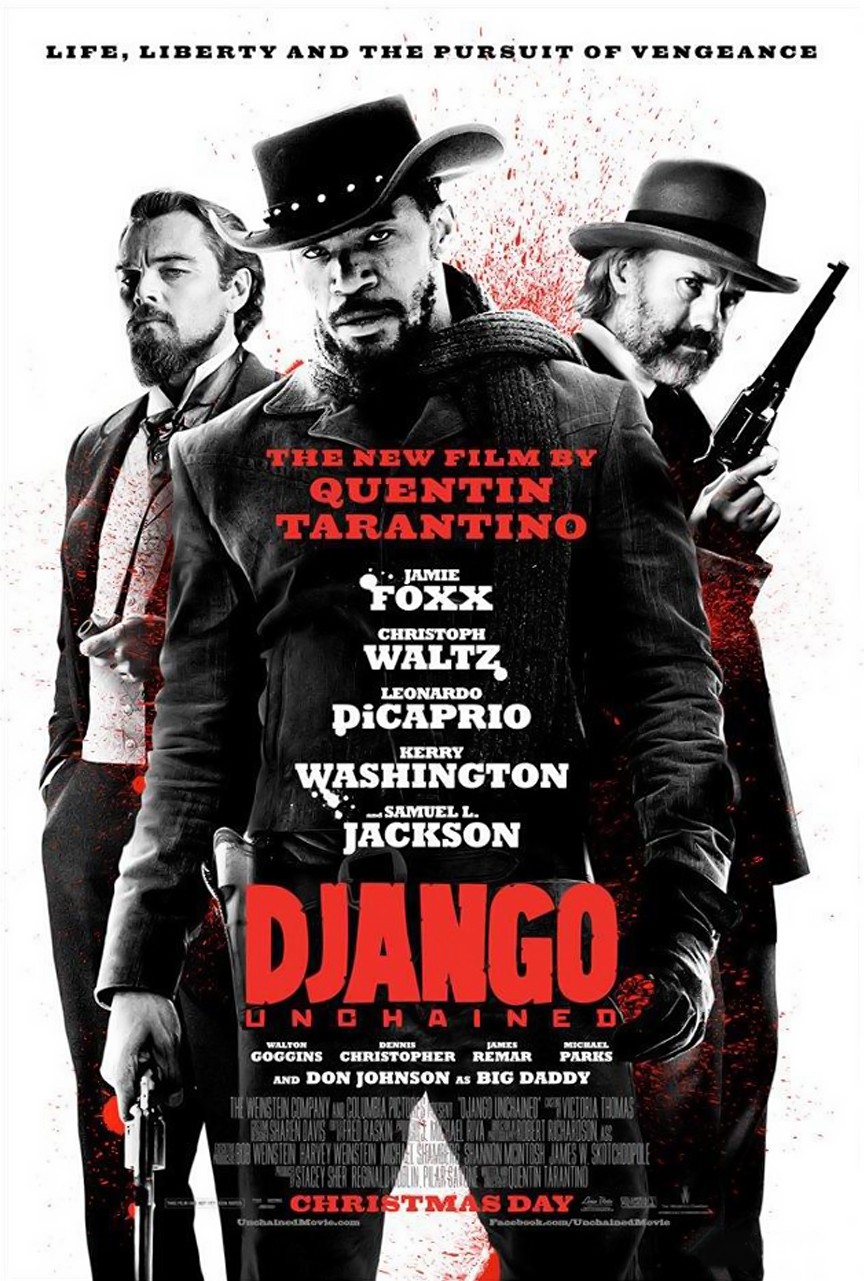
Django Unchained Review

Django Unchained is grimy, gorgeous and gory, a flawless spaghetti western in what is Tarantino's finest film since Pulp Fiction 


Quentin Tarantino returns to our screens this weekend with his first film since 2009's Inglorious Basterds, it's already up for numerous awards including 5 Oscars, it also won 2 Golden Globes recently in the form of a Best Supporting Actor win for Christoph Waltz and Best Original Screenplay for Tarantino. The film has been critically acclaimed, but it seems no Tarantino film comes without controversy and Django has been criticised for its use of graphic violence, especially in the days following the Sandy Hook Elementary School shooting. It has also been criticised for its use of racial language, not just by critics but also the acclaimed director Spike Lee. 

Bringing us a dark southern feast of grit and blood, Tarantino's latest period epic is sensational. The film stars Jamie Foxx as the titular slave Django, Christoph Waltz plays the German bounty hunter and partner to Django, Dr King Schultz. Kerry Washington appears as Broomhilda, Django's wife, while also teaming up with Foxx for the first time since 2004's Ray. Leonardo DiCaprio portrays dictator like plantation owner Calvin Candie while Tarantino regular Samuel L. Jackson plays Candie's loyal butler, Stephen. 


Set in the deep south, in the heart of Texas, the film begins with Christoph Waltz's bounty hunter, Dr King Schultz, in search of a particular slave he needs the help of, in order to chase down three wanted brothers. He finally comes across the man he needs, Django, who he hastily frees and explains his situation too. The two partner up to serve revenge, southern style, to the outlaws and gang members of Texas. Dr King soon discovers Django's back story, he has a wife, Broomhilda (Washington), who was taken from him, he intends to find and free her once he and King have finished their work together. King soon realises Django's bounty potential, and offers Django his help to free his wife.

After some investigation, both men set out to find notorious plantation owner and the man who purchased Broomhilda, Calvin Candie (DiCaprio). Django and King set up a front, and claim to be wanting to buy into Candie's Mandingo fighting business, a brutal and gladiator style fight to the death between savagely maltreated slaves. Yet all the while their aim is to merely free Broomhilda. Candie and our two heros get cosy and strike up a deal to purchase one of Candie's fighters, but also express an interest in purchasing Broomhilda, with Candie not yet having any suspicions that they know her. Stephen (Samuel L. Jackson), Candie's elderly and loyal butler, suspects something is up and alerts his master. Knowing he is being duped by the two bounty hunters, Candie demands $12,000 for Broomhilda or he will shoot her, King and Django of course give in and agree to pay the money. However, King, becomes distressed and angry after seeing Candie's treatment of his slaves, and eventually snaps, killing Candie, confessing 'I couldn't help myself' before being shot by Candie's bodyguard. What follows are two riotous shoot outs in which Django shows just how quick a gunman he really is, and eventually, he leaves with Broomhilda, after killing virtually every associate of Candie.

Tarantino's direction of Django Unchained is brilliantly bold, from stylistic elements to casting choices to cinematography, Tarantino somehow manages to make this violent opera beautiful. Just like Inglorious Basterds before it, he creates his own little piece of history, his own take on a dead genre and whips up a refreshing yet brutal beast of a film which delivers in every sense of the word. His script is also flawless, and that Golden Globe for Best Original Screenplay is throughly deserved. In particular, a 5 minute scene with the KKK which also includes a cameo from Jonah Hill is so delightfully written, it already sticks out in my mind as one of the funniest scenes of any Tarantino film. This is another masterpiece and a continued return to form from the Pulp Fiction director after 2009's lack lustre Deathproof.


I can already guarantee that 2013's most badass performance will come from Jamie Foxx for this portrayal of Django. No one could be more perfectly cast for the character, and i'm astonished no one gave Foxx a Best Actor nomination at any of the awards this year. From the opening scene in which he so cooly throws his rag off in the dead of night to the film's finale where he looks on at the burning Candie mansion with his ice cool demeanour, Foxx's performance is nothing short of brilliance. He approaches each scene with such superb swagger and style, such arrogance and cool detachment its hard to not leave the cinema wishing you were Jamie Foxx.

Christoph Waltz takes the playful nature from his Inglorious Basterds performance but channels it into the much more good natured and well meaning Dr King Schultz. The German Schultz is very much an intriguing character, posing as a dentist, he travels round the beaten back tracks of the deep south tracking down and killing wanted outlaws as well as proclaiming his opposition and distate for slavery in the country. He is the true good guy of the movie, while Django can watch slaves be brutalised because he's already seen it, Schultz almost lets his guard down several times as he shows his obvious disgust at the treatment of Candie's slaves. He is very much an incredibly likeable character, and Waltz brings his own flamboyance and cheer to Schultz, his Oscar nomination is well deserved.

But the film's highlight performance is surely Leonardo DiCaprio's Calvin Candie. A frightful, wicked, power hungry boy-prince who's apparent evil knows no bounds, his portrayal his reason enough to pay full price to see this. Candie is so charming and aloof yet so brutal, so unnerving, and his ability to turn from delightful businessman to raging and vile racist in a second is incredible. Again DiCaprio should have at least been nominated for Best Supporting Actor this coming awards season, but the Academy's continued shunning of the actor has shamefully continued. The scene in which Candie slams his hand on the table and begins bleeding was never in fact planned, DiCaprio shed blood for this part and you can see in this scene in particular that DiCaprio is so engrossed in his performance.


Kerry Washington plays the role of Broomhilda with under stated fragility, you can see the torture in her eyes of what she's seen, yet you also see what Django sees, the breathtaking beauty and respectful, quiet nature of the character, it is all put across brilliantly by the 35 year old actress. In many ways Washington has one of the hardest parts to play, yet she plays it with under rated resilience. Samuel L. Jackson's character, the wretched house butler Stephen, is in many ways more detestable than Candie, as Django appears to recognise. Even Jackson deserves some kind of awards recognition for this performance, its despicable, loathsome and cowardly. Jackson's begrudging eyes say it all in a performance for a character who is just as intriguing as Schultz, as he appears to contribute to the disgusting racist attitude of the period just as much as Candie does.

Despite its gallant and fearless nature, what I love most about Django Unchained is that when you strip it down to its basic elements, it is essentially a love story, and thats where Tarantino's direction really shows its brilliance. If you remove the blood and the racism, it is a simple story of a dedicated husband just trying to be with his wife again, and that's where the film shows its beauty. In defence of the film's racist language, Tarantino has set out to create a genuine and authentic western, and in its historic context I see nothing offensive about the film's language.

Django Unchained is a beastly, riotous, sensational film, with not only fantastic performances all round by a perfect cast, it is also so well put together in terms of vision and style. 5/5


P.S. Django Unchained would have topped my Best of 2012 list if i'd seen it earlier.